
1980 Dollar Coins vs True Silver Dollars
Comparing the 1980 dollar coin with the historical silver dollar requires a detailed study of their physical composition and market value.
The distinction between these categories stems from the U.S. Mint's transition to base metal alloys starting in the mid-1960s.
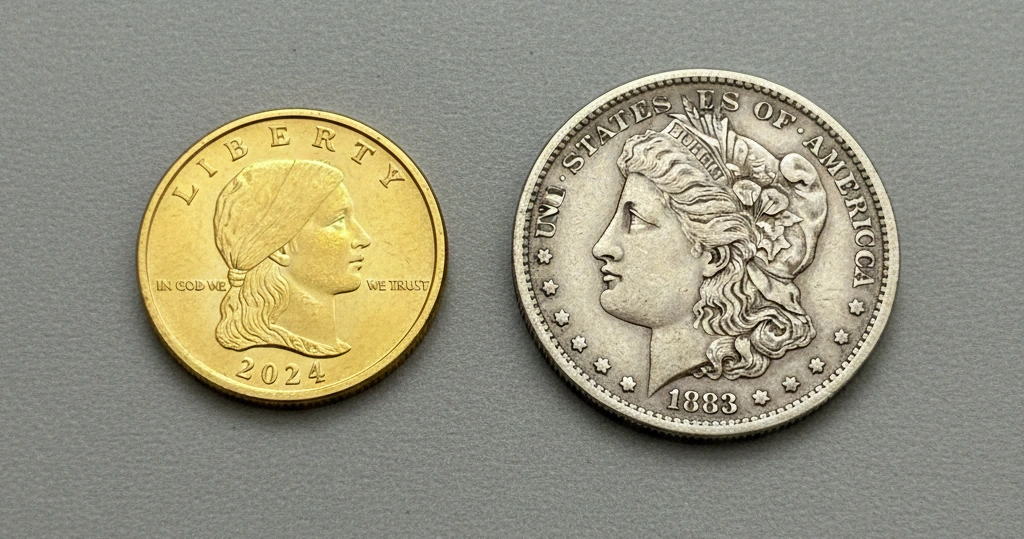
Characteristic | 1980 Susan B. Anthony Dollar | True Silver Dollar (Morgan/Peace) |
Issue Period | 1979–1981, 1999 | 1878–1904, 1921–1935 |
Material | Copper-nickel clad copper | 90% Silver, 10% Copper |
Weight | 8.1 grams | 26.73 grams |
Diameter | 26.5 mm | 38.1 mm |
Silver Content | 0.00 grams | 24.05 grams |
The 1980 coin possesses significantly smaller dimensions and weight, comparable to the parameters of a quarter dollar.
The absence of precious metal in the 1980 issue determines its value, depending exclusively on collectible preservation.
1980 Mintage Statistics
In 1980, minting occurred at three mint facilities, providing a significant volume of money supply.
High production figures make common specimens available for circulation, limiting their value to face value.
Philadelphia (P): 27,610,000 pieces.
Denver (D): 41,628,708 pieces
San Francisco (S): 20,422,000 pieces
San Francisco (S) Proof: 3,554,806 pieces
The total 1980 mintage exceeded 93 million specimens.
This volume is significantly lower than the 1979 mintage, totaling over 750 million pieces, creating conditions for higher valuations of preserved 1980 coins.
1980 Dollar Value Assessment
The market price of a 1980 coin varies depending on the Sheldon scale grade.
Most coins having been in circulation are valued at $1.00.
Grade (MS) | 1980-P (USD) | 1980-D (USD) | 1980-S (USD) |
MS63 | $2 - $4 | $2 - $4 | $2 - $4 |
MS65 | $10 - $15 | $12 - $18 | $10 - $15 |
MS67 | $50 - $80 | $60 - $100 | $40 - $70 |
MS68 | $1,500+ | $1,200+ | $400+ |
Coins in MS68 condition occur extremely rarely due to the softness of the copper-nickel alloy being susceptible to mechanical damage.
The price for MS67 specimens demonstrates a stable annual growth of approximately 3–5%, resulting from the gradual absorption of the market by certified coins.
Auction Records for 1980 Coins
Record sales are recorded in segments of the highest preservation and rare technological defects.
Analyzing data from professional grading services like the coin value app, PCGS, and NGC allows for identifying maximum price thresholds.
1980-P MS68 (PCGS): Sold in 2017 for $2,820.
1980-D MS68 (PCGS): Realized in 2022 for $1,645.
1980-S MS68 (PCGS): Sold in 2011 for $920.
The presence of original mint luster and the absence of scratches on the Susan B. Anthony portrait are critical pricing factors.
The investment attractiveness of these positions is limited to a narrow circle of lots having passed certification.
Characteristics of True Silver Dollars
Classic silver dollars (1878–1935) possess intrinsic value determined by precious metal quotes on the exchange.
Their value never drops below the cost of the silver contained within them.
Melt Value: Calculated as 0.7734 ounces of silver multiplied by the current spot price.
Rarity Premium: A numismatic markup ranging from 20% to 500% or higher is added to the metal value.
Pure Silver Weight: Amounts to 24.05 grams, ensuring high material density of the coin.
At a silver price of $30 per ounce, the minimum value of any such coin is approximately $23.20.
This creates a fundamental difference from the 1980 dollar having zero intrinsic metal value.
Record Prices for Silver Dollars
To compare price scales, one must consider records of classic silver coins.
1889-CC Morgan Dollar MS68: Sold for $881,250.
1893-S Morgan Dollar MS67: Sold for $735,000.
1921 Morgan Dollar MS67+: Value reaches $15,000–$20,000.
Silver dollars demonstrate an average collectible value growth of 8–12% per year during long-term ownership.
During periods of economic instability, growth may accelerate to 15–20% per year due to the link to precious metal.
1980 Technological Varieties
In 1980, no significant design changes were recorded similar to those in 1979 (differences in rim width).
However, specific minting errors exist, increasing the coin's value by 200–500%.
Off-Center Strike: Image displacement of 10% or more.
Broadstruck: Minting outside the retaining collar resulting in diameter expansion.
Die Cracks: Deep cracks on the surface indicating die wear.
Coins with 1980 minting errors in MS65 grade can be valued at $150–$300.
Comparative Durability Analysis
The copper-nickel alloy of the 1980 dollar possesses higher hardness compared to the .900 fine silver alloy.
Silver, being a softer metal, loses fine relief details faster when being in circulation.
Silver Dollars: Lose up to 1% of weight over 10 years of active circulation.
1980 Dollars: Retain weight practically unchanged for decades.
Despite physical strength, the 1980 Anthony series design is considered less resistant to visual perception due to shallow relief.
Economic Aspects and Purchasing Power
The 1980 Susan B. Anthony dollar issue was aimed at replacing $1 paper banknotes.
Economic efficiency consisted of increasing the monetary unit's service life (30 years versus 18 months for paper).
Production Costs: In 1980, minting one coin cost approximately 3 cents.
Rejection of Use: Due to its similarity in size to the 25-cent coin, the 1980 dollar did not gain wide distribution.
Storage: Billions of these coins remained in Federal Reserve vaults until the release of the Sacagawea series in 2000.
Identification and Storage
To identify the authenticity of a 1980 coin, checking it with a free coin identifier app and a magnet is sufficient.
Copper-nickel alloy and .900 fine silver are not magnetic materials.
For silver dollars, using capsules preventing patination is recommended.
For 1980 dollars, preventing the appearance of contact marks from touching other coins is more important.